You want the beach at your doorstep, but you also want the right mix of privacy, cost, and long‑term value. On Folly Beach, that usually means choosing between true oceanfront or the second row just one house back. In this guide, you’ll compare price, views and access, privacy, risk, insurance, rentals, and financing so you can decide what fits your goals. Let’s dive in.
Folly Beach price snapshot
As of early 2026, public market summaries place typical Folly Beach values around the low to mid seven figures. Because Folly is a small island market, a few high‑end sales can swing monthly medians. Rather than rely on a single “median,” focus on recent comps for your specific block and lot. A tailored CMA will show how much premium a given oceanfront or second‑row home commands right now.
Oceanfront vs second row at a glance
| Factor | Oceanfront | Second row |
|---|---|---|
| Purchase price | Sits at the top of the market. Premium varies by lot width, elevation, condition, rental history, and flood zone. | Often lower entry price for similar bedroom counts. Basis can improve ROI if operating costs are lean. |
| Views | Unobstructed water views. Sunrise from your porch. | Partial or oblique ocean views from upper floors or a rooftop deck on many homes. |
| Beach access | Shortest walk to the sand; many properties have direct paths. | Still a quick stroll via public access points and beach parks. See Folly Beach County Park details. |
| Privacy and noise | Can experience more foot traffic, especially near the pier and Center Street. | Often a bit quieter, depending on the block and nearby activity. |
| Insurance | Frequently in coastal high‑hazard V or VE zones, which can mean higher flood and wind costs. | Often A or AE zones or mixed. Flood may still be required if in a Special Flood Hazard Area. |
| Maintenance | Greater exposure to salt spray and wind. Expect more frequent exterior upkeep and walkover repairs. | Coastal wear still applies, but typically less intense than front‑row exposure. |
| Rental potential | Often achieves higher ADRs on top listings. | Competitive yields possible given lower basis and similar walk‑to‑beach appeal. |
| Resale | Premium view and access help long‑term demand, but days on market vary by product and price. | Broader buyer pool at some price points; performance depends on design, location, and compliance. |
Views, access, and daily feel
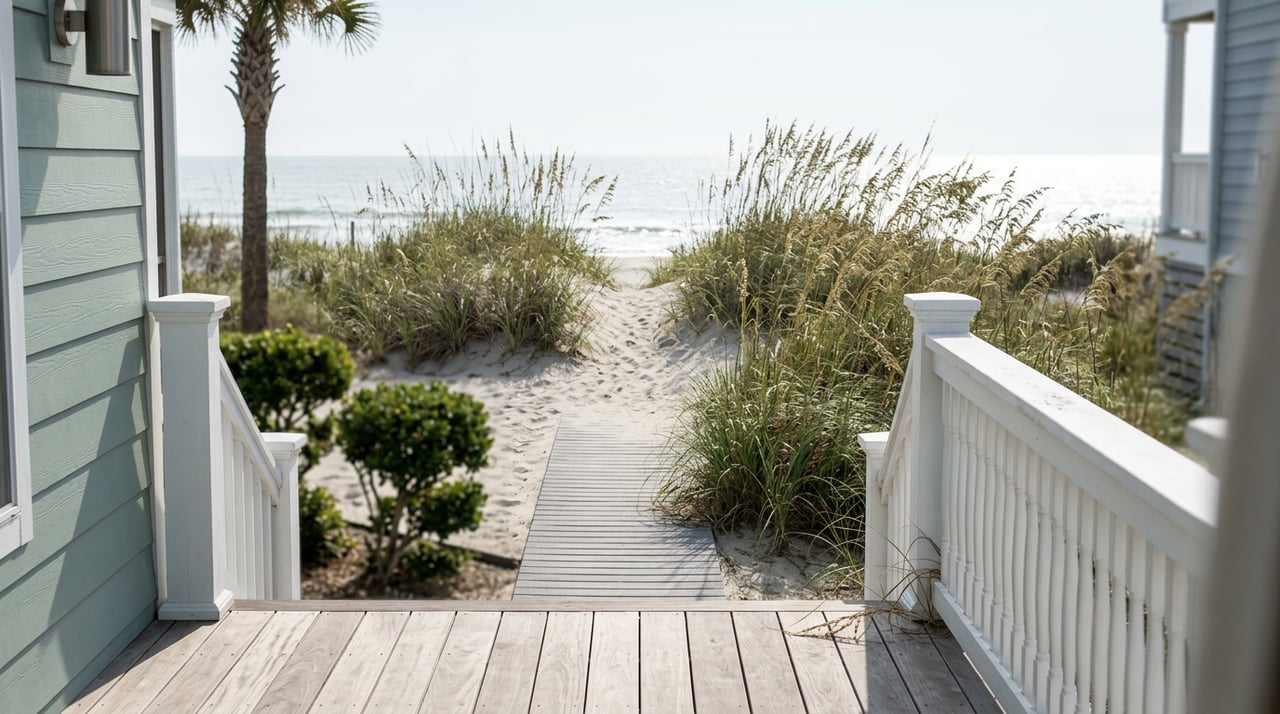
If sunrise coffee on the porch is your must‑have, oceanfront delivers the clearest, uninterrupted views. You’ll also have the shortest path to the sand. Second‑row homes can still offer wide glimpses and breezes from upper levels, especially on taller builds.
Folly Beach maintains multiple public access points and beach parks, so the second row usually means only a few extra minutes to the water. Review county park and access information to map nearby entries. For privacy, note that oceanfront homes close to the pier and Center Street see heavier seasonal foot traffic, while second‑row streets can feel calmer.
Coastal risk and rules that shape value
Flood zones and elevation basics
Many Folly parcels fall within FEMA Special Flood Hazard Areas. The City requires elevation certificates and coastal design standards for new and substantially improved buildings. Before you write an offer, confirm the current FEMA flood zone and ask for any existing Elevation Certificate through the City’s flood information page.
Beach renourishment and long‑term water trends
Folly Beach partners with the U.S. Army Corps of Engineers on recurring beach renourishment that adds sand and reduces near‑term erosion pressure. You can track recent work on the City’s 2024 beach renourishment updates. Over the long run, regional sea level has been rising per the Charleston tide gauge record; see NOAA’s local trend data when planning multi‑decade ownership and reserves.
Seawalls, dunes, and permitting
Local rules on seawalls and dune management have been under review, including proposed setbacks and ordinance revisions. These policies can affect what a beachfront owner may build or repair. If a property involves a revetment or seawall, review the City’s current materials and recent draft ordinance language, such as this policy document, and verify permit history with City Hall.
Insurance and maintenance: what to budget
Flood and wind, in plain terms
If you finance a home in an SFHA, your lender will require flood insurance for the life of the loan. Standard homeowners policies in coastal South Carolina often include a separate named‑storm or wind deductible that is a percentage of the dwelling coverage. Review that deductible carefully and see state disclosure requirements in the South Carolina Insurance Code. Obtain both NFIP and private flood quotes early, especially on oceanfront where coverage needs can exceed basic limits.
Why oceanfront costs more to maintain
Salt air, sand, and wind accelerate wear on roofing, siding, decks, railings, and metal fasteners. FEMA’s coastal building science guidance recommends corrosion‑resistant materials and more frequent inspection schedules. For planning, expect line items like pile and deck inspections after storms, quicker repainting cycles, HVAC replacements, and dune walkover upkeep. See FEMA’s Building Science resources for durability best practices.
Short‑term rental: returns and rules
Demand and modeling
Folly Beach supports strong seasonal demand, and top oceanfront listings can command higher average daily rates. That said, second‑row homes with excellent design and proximity can deliver compelling yields due to their lower basis. Use third‑party data for starting assumptions and validate with a local manager. For a snapshot, review market‑level STR metrics before you build a conservative pro forma.
Licensing and caps
Folly Beach requires licensing and registration for short‑term rentals and has adopted limits on the number of STR licenses. The cap discussion culminated in a 2023 vote to restrict total licenses, and the City updates its rules and applications periodically. Read an overview of the vote in the local press and confirm specifics in the City’s STR documents. For context on the vote, see this coverage. Always verify current eligibility and license status before assuming rental income.
Financing and valuation tips
Second home vs investment
Tell your lender how you plan to use the property. Second‑home and investment classifications differ on down payment, qualifying rules, and rate. If you expect regular short‑term rentals, many programs will treat the home as an investment property. Get pre‑approved with your intended use before you make offers.
What appraisers weigh
On Folly, view corridor, lot width and elevation, buildable footprint, and flood zone all shape value. For income properties, some lenders permit rent schedules or market STR data within the appraisal, while others do not. Ask your lender what the valuation will consider so you can prepare relevant documents.
A simple decision checklist
- Step A — Clarify goals
- Full‑time living, second home with occasional rental, or STR‑focused investment.
- Step B — Address hard constraints early
- Check flood zone and request any Elevation Certificate via City resources.
- Obtain flood and wind quotes and note the named‑storm deductible amount.
- Confirm STR license status and cap eligibility in the City’s STR documents.
- Step C — Build a conservative pro forma
- Compare purchase price, expected ADR and occupancy, operating costs, and financing terms. Use market data like STR snapshots as a baseline, then validate locally.
- Step D — Extra diligence for oceanfront
- Hire a surveyor or engineer to verify elevations and shoreline exposure. Review any seawall or revetment with a coastal engineer and confirm permits.
- Step E — Talk to specialists
- Coastal insurance agent, lender experienced with second‑home or STR loans, and a Folly property manager for true operating costs and policies.
Quick case snapshots
- Oceanfront: Recent oceanfront condo and single‑family sales on West Arctic and East Ashley have ranged from the high six figures for condos to multiple millions for houses, depending on size, elevation, and condition. That spread reflects view quality, construction, rental history, and flood zone.
- Second row: Nearby second‑row homes often trade in the seven figures at a discount to comparable oceanfront lots. Many still enjoy quick public access and partial views, which can support strong personal use and rental appeal.
Ready to compare specific blocks, flood zones, and rental paths for your short list? Let’s tailor a side‑by‑side with current comps, insurance quotes, and STR eligibility so you can move forward with confidence. Reach out to Lisa Nicole Thornton for a personalized consultation.
FAQs
How big is the price premium for oceanfront on Folly Beach?
- It varies by lot width, elevation, buildable area, and condition. Oceanfront usually sits at the top of the market, while second‑row often sells at a discount. Use a block‑specific CMA to quantify the premium.
Do I need flood insurance for a Folly Beach home?
- If the home is in a Special Flood Hazard Area and you finance it, lenders will require flood insurance for the life of the loan. Even outside mapped zones, getting quotes is wise. Start with the City’s flood information.
Are oceanfront homes always better for STR income?
- Oceanfront can achieve higher nightly rates, but the higher purchase price and maintenance can offset returns. Second‑row homes can produce competitive yields thanks to lower basis and similar beach access.
How do wind deductibles affect my costs?
- Many coastal policies use a separate named‑storm or wind deductible as a percentage of your dwelling coverage. Review disclosures and the state insurance code so you understand worst‑case out‑of‑pocket.
Will sea‑level rise affect value and ownership costs?
- Over time, higher sea levels can increase flooding frequency and maintenance needs. Folly’s renourishment program reduces near‑term erosion, but plan with NOAA’s local sea‑level trend in mind and keep healthy reserves.
